

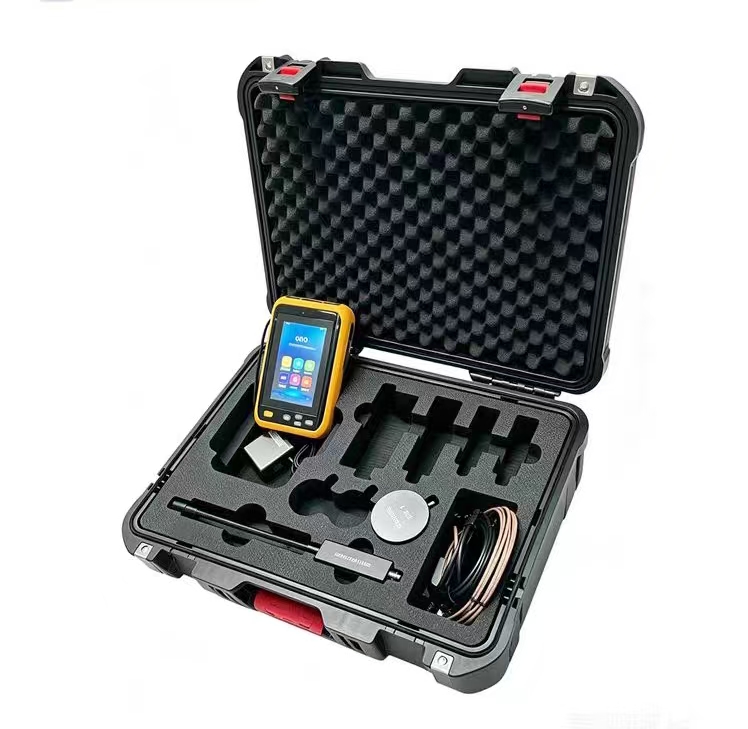
Transformer Ratio Tester
The Transformer Ratio Tester (also known as the Ratio and Group Tester, or the Automatic Ratio and Group Comprehensive Tester) is a portable specialized testing instrument with a microcontroller at its core, used for precisely measuring the turns ratio (ratio), connection group, tap changer status, and electrical performance of power transformer windings. It is an essential tool in transformer production inspection, acceptance testing, and preventive maintenance testing.
Core Measurement Parameters
The ratio tester mainly measures two key parameters:
Ratio (turns ratio): The voltage ratio between the high-voltage winding and the low-voltage winding (rated high voltage / rated low voltage). By comparing the measured ratio with the nameplate value, it can be determined whether the number of winding turns is correct and whether there are defects such as inter-turn short circuits.
Connection Group: The phase relationship between the high-voltage and low-voltage windings, expressed using the clock notation (e.g., Yyn0, Dyn11, etc.). Transformers with inconsistent connection groups connected in parallel can lead to short-circuit accidents, so accurately identifying the group is crucial.
In simple terms, the ratio tester checks whether the number of winding turns is correct through the "ratio" and whether the wiring phase relationship is correct through the "group".
Working Principle
Modern ratio testers adopt digital synthesis signal source technology: the instrument is controlled by a microcontroller internally. After inputting single-phase power, it synthesizes standard three-phase sinusoidal signals through digital signal processing (DSP), which are output to the high-voltage side of the transformer through a high-fidelity power amplifier. Simultaneously, it samples the voltage amplitude and phase on both the high and low voltage sides, and calculates the ratio, error, and group.
Compared with the traditional QJ35 ratio bridge, modern ratio testers have significant advantages:
Low test voltage, high safety, no damage to the equipment
Test results are not affected by fluctuations in the frequency and amplitude of the power supply
One-time wiring can automatically complete three-phase ratio and group tests
Supports blind test function, capable of measuring without prior knowledge of transformer parameters
Key Technical Parameters
Table
Download as Table
Export as Image
Parameter Typical Range
Ratio Measurement Range 0.9 ~ 10000
Ratio Measurement Accuracy 0.1% (≤200), 0.2% (200~2000), 0.3% (2000~10000)
Group Range 0~11 points (equivalent to 1~12 points)
Phase Angle Resolution 0.01°
Phase Angle Measurement Accuracy 0.1°
Ratio Resolution 0.0001
Output Voltage AC 5V / AC 25V
Power Supply AC 220V±10%, 50Hz
Measurement Speed Three-phase test completed in 8~35 seconds for one set of data
Operating Temperature -5℃ ~ 40℃
Relative Humidity <85%
Weight 1.34kg (handheld) ~ 8kg (desktop)
National standard GB1094 stipulates: The allowable deviation for the voltage ratio of power transformers is 0.5% (for transformers below 35kV and with a ratio less than 3).
Main Functions
Automatic measurement of connection group: Automatically identifies various connection methods such as Yy, Yd, Dy, Dd, Zn/y, Zn/d
Blind test function: Can directly measure the ratio and group of unknown transformers without pre-entering ratio parameters and connection methods
Tap test: Can quickly measure the ratio and error at each tap changer position, with the rated ratio needing to be entered only once
Hexagonal diagram display: Results are displayed in numbers and hexagonal vector diagrams for intuitive judgment of the connection group situation
Single-phase/three-phase compatibility: Can perform both single-phase measurement and automatic three-phase winding testing
Data management: Built-in memory can save 20~1000 sets of historical data, supporting U-disk export and Bluetooth printing
Safety Protection Mechanisms
High and low voltage reverse connection protection: Automatically alarms when wiring is incorrect to prevent damage to the instrument
Output short circuit protection: Automatically cuts off output when test leads are short-circuited
Overcurrent/overvoltage protection: Automatically powers off under abnormal conditions
Low voltage testing: Test voltage is only 5V~25V, safe to operate, and does not damage equipment
Typical Application Scenarios
Factory inspection: Detection of ratio and group for semi-finished and finished products during transformer production
Acceptance testing: Before new transformers are put into operation, verify that the ratio and group match the system requirements
Preventive maintenance testing: Regularly inspect transformers in operation to check for winding deformation, inter-turn short circuits, and other faults
Tap changer testing: For on-load or off-load tap-changing transformers, measure the ratio at each tap position to verify that the tap changer operates correctly and has good contact
Parallel operation verification: Confirm that multiple transformers have consistent connection groups to meet the conditions for parallel operation
Fault diagnosis: Conduct targeted testing when winding defects are suspected in transformers
Executive Standards
GB 1094: Power transformer standard (specifies allowable ratio deviation)
DL/T 963-2005: Technical conditions for transformer ratio and group testers
DL/T 911-2004: Relevant standards for winding deformation testing of power transformers
Key Operating Procedures
Safety measures: Strictly implement the procedures of power outage, voltage verification, and grounding wire installation, and confirm that the transformer is completely de-energized and has no residual voltage
Wiring: Connect the high-voltage terminals (A, B, C) to the high-voltage side of the transformer, and the low-voltage terminals (a, b, c) to the low-voltage side, strictly avoiding reverse connection
Parameter settings: Input the rated high voltage, rated low voltage, rated ratio, total number of taps, and tap spacing
Test execution: Adjust the tap changer step by step, wait for the data to stabilize at each position before saving, and strictly avoid skipping taps during testing
Data output: After testing, print reports or export data to a computer via U-disk