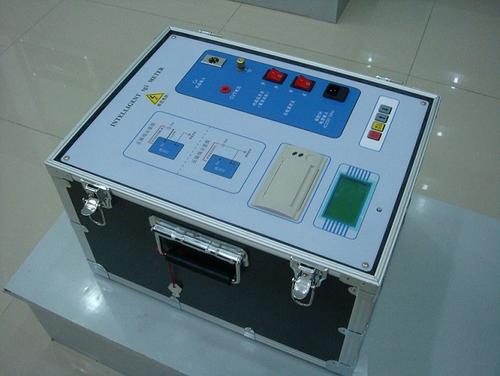

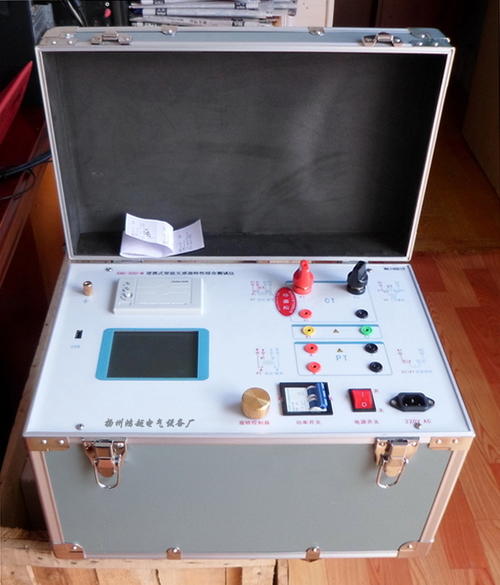
Loop Resistance Tester
The loop resistance tester, also known as a contact resistance tester or micro-ohmmeter, is a precision instrument specifically designed to measure the contact resistance of conductive circuits in high-voltage circuit breakers, disconnectors, GIS, and other power equipment. Its core purpose is to determine whether equipment connections are good by detecting the resistance value at contact points, thereby preventing serious accidents such as local overheating, oxidation, or even burnout caused by excessive contact resistance.
⚙️ Core Working Principle
Modern loop resistance testers generally adopt the DC voltage drop method (four-wire/Kelvin measurement method):
Constant current output: The instrument applies a stable large DC test current (national standards require no less than 100A) to the circuit under test through a pair of current terminals (I+, I-).
Voltage sampling: Simultaneously, it measures the voltage drop across the resistance under test with high precision through another pair of voltage terminals (V+, V-).
Automatic calculation: The internal system automatically calculates and displays the resistance value based on Ohm's law (R=U/I).
The key advantage of the four-wire method is that it completely eliminates the influence of test lead resistance and connection contact resistance on measurement results, thereby achieving high-precision micro-ohm level resistance values.
Key Standards and Acceptance Criteria
When conducting tests and judging results, the following current national and industry standards must be followed:
Instrument standard: DL/T 845.4-2019 "General Technical Specifications for Resistance Measuring Devices - Part 4: Loop Resistance Testers" is the current effective standard, replacing the old version DL/T 845.4-2004.
Verification regulation: The JJG 1052 series regulations specify the verification requirements for instruments, typically with a verification cycle of once per year.
Test procedure: DL/T 596-2021 "Preventive Test Procedures for Power Equipment" specifies the test cycles, methods, and acceptance criteria for various types of equipment.
Acceptance Judgment Principles
To determine whether the loop resistance is acceptable, one should not rely solely on a fixed value but should consider the following three points comprehensively:
Compliance with manufacturer specifications: The measured value should not exceed the specified value given in the manufacturer's technical documents.
Compliance with industry standards: It is generally required not to exceed 110% of the factory test value, and there should be no significant increase compared to previous test data (e.g., increase not exceeding 20%).
Three-phase balance: For three-phase equipment, there should be no significant difference among the measured values of each phase. If a certain phase shows a continuous rise relative to its historical baseline or if there are obvious differences among phases, further inspection should be arranged.
🛠️ Key Points for On-site Operation
To ensure safety and data accuracy, on-site testing must be conducted in a standardized manner:
Safety first: Strictly implement the procedures of power outage, voltage verification, discharge, and grounding wire installation to ensure the equipment under test is in a de-energized state.
Environmental check: The test environment temperature should be between -10℃ and +40℃, relative humidity should not exceed 80% without condensation, and strong electromagnetic interference areas should be avoided.
Contact treatment: Before measurement, the switch can be opened and closed several times to break through the oxide film on the contact surface, ensuring the measurement results reflect the actual operating condition.
Standardized wiring: Ensure that the current leads and voltage leads are connected separately at the test points, with firm and reliable contact.
Parameter settings: Select the appropriate test current (typically 100A) and test time (recommended 10-60 seconds) based on the equipment type.
Data recording: After the test, promptly export the data and establish a file, noting the equipment name, test date, environmental conditions, and other information for subsequent trend analysis.
Technology Development Trends
With the development of smart grids, loop resistance testers are evolving from single static measurement to intelligent and comprehensive diagnostic directions:
Dynamic Resistance Measurement (DRM): During the opening and closing operations of circuit breakers, resistance changes are continuously recorded at a very high sampling rate (e.g., 10kHz) to generate a "resistance-travel" curve. This can effectively assess the degree of arcing contact wear, analyze the coordination timing of main/arcing contacts, and detect hidden faults that static measurement cannot capture.
Data trend analysis: The accompanying host computer software supports establishing equipment health files. Through longitudinal (historical data) and horizontal (similar equipment) comparisons, it enables fault prediction based on growth rates, promoting the transition from "periodic maintenance" to "condition-based maintenance."
Portability and intelligence: Handheld, battery-powered designs adapt to the frequent on-site relocation needs; graphical interfaces and intelligent diagnostic algorithms reduce reliance on operator experience.
Reference of Mainstream Brands
Table
Download as table
Export as image
Brand Type Representative Brands Brief Description
Imported brands Megger, DV Power, AEMC Deep technical accumulation, wide product line coverage, outstanding performance in comprehensive diagnostics, data management, and long-term stability, suitable for scenarios requiring high diagnostic depth.
Domestic brands Beijing Kanggaote (KGT), etc. Advantages in localized services, delivery efficiency, on-site portability, and customized development; some products have mastered core technologies such as DRM, offering high cost-performance.
When selecting, one should comprehensively consider test requirements, on-site environment, data management needs, and after-sales service capabilities, not just the output current level.