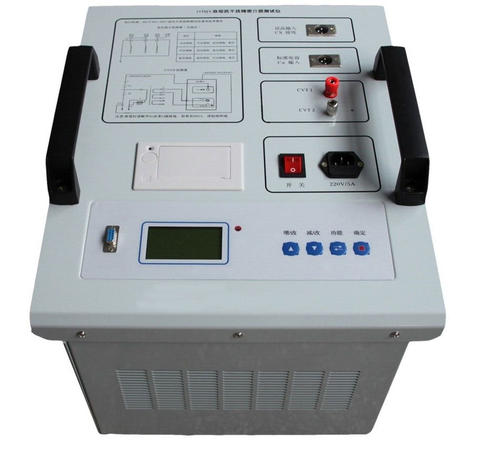

Phase Detector 10kV Wireless High Voltage Phase Detector 35KV Voice Digital Display Phase Detector 220KV Remote Phase Detector
The "10kV, 35kV, 220kV wireless high voltage phase detectors" you mentioned are key safety tools used in power systems to detect whether the phases of two power grids (or generator sets) are identical. These devices are mainly applied for phase verification on both sides of circuit breakers at dual-power grid connections and ring network closure points, to prevent short-circuit accidents caused by inconsistent phase sequences.
Based on relevant technical materials, here is a summary of the core functions, technical features, and selection suggestions for this type of wireless high voltage phase detector:
1. Core Functions and Application Scenarios
Phase Verification and Grid Connection: Used to determine whether the phases of two power grids are identical for safe grid connection.
Phase Sequence Judgment: Can measure and determine the positive phase sequence (120°) or negative phase sequence (240°) of a line.
High Voltage Detection: Has a voltage detection function. When the collector contacts a live line, the host can display corresponding symbols or issue prompts to determine whether the line is live.
Multi-scenario Applicability: Suitable for both high-voltage overhead lines and high-voltage switchgear (such as medium-voltage switchgear and ring main units) for phase verification.
2. Core Technical Features
Wireless Transmission and Remote Operation: Uses wireless transmission technology, eliminating the long leads of traditional wired phase detectors, overcoming terrain limitations. The typical phase verification distance can reach 100 to 200 meters, making operation safer and more convenient.
Satellite Timing and Ultra-long-distance Phase Verification: Some high-end models (such as 220kV remote phase detectors) are equipped with multi-mode satellite timing modules like GPS/BeiDou, with extremely high synchronization accuracy (error less than tens of nanoseconds), enabling ultra-long-distance phase verification between two hosts separated by hundreds of kilometers (e.g., 300 meters to 800 kilometers), and even supporting special environments like basements and mines.
Intelligent Voice and Digital Display Prompts: Equipped with an LCD color screen, displaying phase difference, frequency, vector diagrams, and other data on the same screen; also has a real-person voice broadcast function (such as "same phase", "different phase", "X signal normal", etc.), solving the problem of reading difficulties when the distance is far or visibility is low.
Contact and Non-contact Phase Verification:
Contact type: Usually suitable for bare conductors with voltage levels of 35kV and below.
Non-contact type: For high-voltage lines of 110kV, 220kV and above, non-contact phase verification must be used. By placing the detector close to the conductor (without direct contact), the electric field signal can be sensed to complete phase verification, greatly improving operational safety.
3. Common Technical Parameter Range
Applicable Voltage Levels: Wide span, from low voltage (such as 10V, 220V) to ultra-high voltage (110kV, 220kV, even 500kV) can be covered.
Phase Difference Accuracy: Usually between ±5° and ±10°, with high-precision satellite timing models having errors less than 0.1°.
Insulating Rod Configuration: Equipped with high-performance moisture-proof insulating rods, with lengths strictly configured according to voltage levels (for example, the effective insulation length for 10kV is usually 0.7m, for 35kV is 0.9m, and for 220kV it needs to be above 2.1m), ensuring the safe distance between personnel and live parts.
💡 Selection and Procurement Suggestions
When purchasing or customizing wireless high voltage phase detectors, it is recommended to clarify the following key information with the manufacturer:
Actual Working Voltage Level: Clarify whether your main test object is 10kV, 35kV, or 220kV, as this directly determines the length of the insulating rod and whether a non-contact probe is needed.
Phase Verification Distance Requirement: If it is for double-circuit lines on the same tower or adjacent substations, ordinary wireless phase detectors are sufficient; if it is for cross-regional power grids, long-distance transmission lines, or underground pipe galleries, you need to purchase remote phase detectors with GPS/BeiDou satellite timing functions.
Safety Qualification Certification: Be sure to verify whether the product complies with national power industry standards (such as DL/T 971, etc.), and require the manufacturer to provide formal insulation withstand voltage test reports and factory calibration certificates.