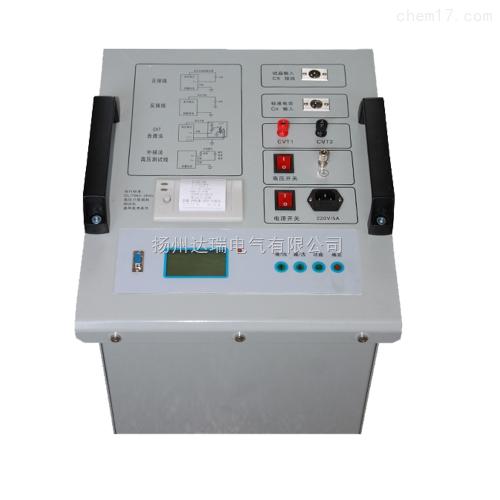

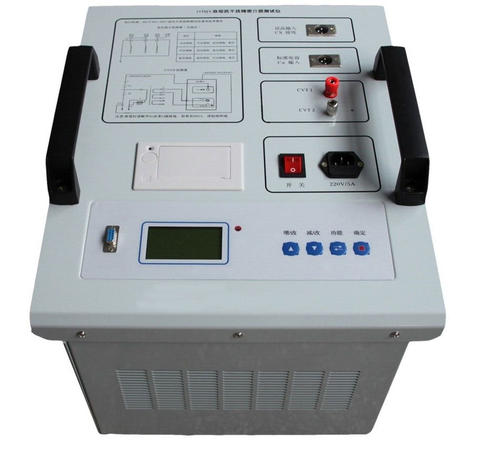
Transformer DC Resistance Tester for Installation, Maintenance, and Testing Qualification / 10A20a40a with Printing Battery DC Resistance Meter
Regarding your "Installation, Maintenance, and Testing" qualification and on-site operation needs, the 10A/20A/40A transformer DC resistance tester with printing and battery power supply that you are interested in is core equipment for power construction and maintenance.
Based on the latest market product information, I have compiled selection key points, mainstream parameter comparisons, and pitfall avoidance guidelines to help you quickly lock in equipment that meets qualification requirements and is suitable for on-site use.
Core Selection Indicators: Current and Capacity Matching
The key to selecting the test current (10A/20A/40A) lies in the capacity of the transformer under test and the resistance value of the low-voltage side winding. The larger the current, the stronger the anti-interference capability and the faster the test speed, but the equipment size and weight will also increase.
Table
Download as Table
Export as Image
Test Current Applicable Transformer Capacity (Reference) Typical Measurement Range On-site Operation Characteristics
10A 10kV level, ≤120MVA 1mΩ ~ 20kΩ Lightweight, suitable for distribution transformers and pole-mounted transformers, can be carried by one person
20A 35kV~110kV level, ≤240MVA 1mΩ ~ 20Ω Mainstream choice, balancing speed and portability, suitable for most substation maintenance
40A 110kV~220kV level, ≤360MVA 1mΩ ~ 8Ω For large transformer low-voltage side (copper foil winding), more stable testing
Experience suggestion: If you mainly perform testing for substations at 110kV and below, 20A is the most cost-effective choice; if you are involved in 220kV main transformers or large wind/solar booster stations, it is recommended to go with 40A or a three-phase DC resistance tester (such as 10A+10A simultaneous measurement mode).
Key Truths About "Battery Power Supply"
You specifically mentioned "battery", which is very important for outdoor or no-power sites, but the following technical details should be noted:
High current ≠ pure battery: Most DC resistance testers labeled as 20A/40A on the market require 220V AC power at the maximum current setting. Because high-current discharge demands extremely high battery rate capability, pure battery operation is difficult to maintain stable output for long periods, and the equipment would be very heavy.
Real uses of the battery:
Low current settings: The 1mA~1A range typically supports pure battery operation, used for measuring high-resistance windings or auxiliary testing.
Data retention and printing: The battery is used to maintain memory, clock, and printer operation, preventing data loss during power outages.
Auxiliary charging: Some high-end models (such as lithium battery versions) support battery-powered 10A testing, but battery life is short (usually about 10-20 tests), suitable for emergency use.
Purchasing advice: If you must work in completely powerless field conditions, be sure to confirm with the manufacturer: "Does the maximum current setting support pure battery operation?" and "How many consecutive tests at maximum current can be performed on a full charge?"
🖨️ Printing and Data Processing Functions
For testing reports, printing is a must-have, but it is recommended to pay attention to the following advanced features:
Instant printing: Results are printed immediately after testing, no need for later organization.
USB/Bluetooth export: Supports exporting to Excel or PDF formats, making it easy to generate testing reports directly when back at the office, avoiding secondary entry errors.
Automatic conversion: Supports input of copper/aluminum material and ambient temperature, automatically converting to resistance values at standard temperatures of 75℃/115℃, and automatically calculating three-phase unbalance.
Storage capacity: It is recommended to choose a model with storage capacity of ≥200 groups to meet daily workload.
🛡️ Safety and Protection Functions (Testing Red Lines)
Transformers are inductive loads, and extremely high back electromotive force is generated at the moment of power-off. Safety protection is the lifeline of the instrument:
Back EMF protection: Must be available to prevent damage to the instrument or injury to personnel.
Automatic discharge/arc suppression: Automatically releases winding stored energy after testing, with audible/visual alarm or discharge indication, confirming discharge completion before disconnecting wires.
Open circuit protection: Automatically stops output when test leads have poor contact, preventing arcing.
Over-temperature/over-current protection: Prevents internal component overheating during prolonged high-current testing.
📋 Procurement Inquiry Parameter Checklist
When inquiring with manufacturers (such as power equipment factories in Wuhan, Baoding, Yangzhou, etc.), please send the following requirements directly to appear more professional:
Current settings: Clearly specify which of 10A / 20A / 40A is needed (or whether multi-gear adjustable is required, such as 1mA-40A).
Power supply method: Confirm whether AC220V + built-in lithium battery hybrid mode is acceptable, or if pure battery is mandatory.
Printing requirement: Whether a built-in micro printer (thermal paper) is needed.
Qualification requirements: Ask whether a metrology institute calibration certificate or CNAS calibration report is provided (mandatory for testing qualification review).
Test mode: Whether three-phase simultaneous testing (Y/Δ type) or magnetizing assist method (for large transformer low-voltage side) is needed.
Accessories: Confirm test lead length (recommended 5 meters or more for ground-level operation), alligator clip/wiring clip specifications.