

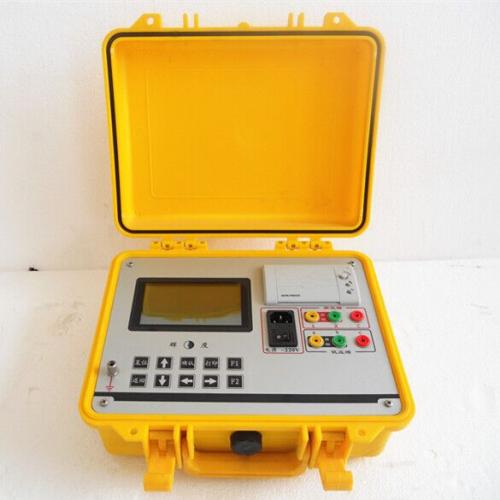
Transformer Turns Ratio Tester
The Transformer Turns Ratio Tester (also known as Turns Ratio and Vector Group Tester) is a core diagnostic device used in power systems to detect transformer performance. It is mainly used to measure the voltage ratio (turns ratio), vector group, and polarity of transformers, making it an indispensable tool for factory inspection, acceptance handover, and routine preventive testing of transformers.
Here is a detailed introduction to the Transformer Turns Ratio Tester:
I. Core Functions and Test Purposes
By applying test signals to the transformer and collecting data, this instrument mainly achieves the following purposes:
Verify winding turns ratio: Verify whether the turns ratio at each tap position of the transformer meets the design requirements, and determine if there are winding errors.
Check tap changer condition: By traversing all tap positions, detect defects such as contact erosion, poor contact, or lead breakage in the tap changer.
Diagnose internal faults: Determine whether the transformer has serious inter-turn short circuits (manifested as severe imbalance in three-phase turns ratio).
Confirm vector group and polarity: Verify that the transformer's connection group is consistent with the nameplate, ensuring that multiple transformers can operate safely in parallel.
II. Main Technical Features
With the development of electronic technology, modern fully automatic turns ratio testers have completely replaced the traditional and cumbersome turns ratio bridges, offering the following advantages:
Intelligent fully automatic measurement: Using microcontroller or DSP digital signal processing technology, it can automatically switch ranges, automatically identify the vector group (supporting blind testing of groups 0-11), and complete the test of three-phase turns ratio, phase angle, and error with a single connection.
Anti-interference and high precision: Internally uses a digitally synthesized three-phase standard sine wave power supply, with fast test speed (usually about 10 seconds) and strong resistance to strong electromagnetic interference on site.
Special transformer testing capability: Not only can it test conventional three-phase/single-phase transformers, but also Z-type transformers, rectifier transformers, Scott transformers, and voltage/current transformers (PT/CT).
Safety and portability: Equipped with high-low voltage reverse connection protection, short circuit protection, etc.; compact in size, supports AC/DC dual use (built-in lithium battery), very suitable for on-site work without power supply.
III. Core Application Scenarios
Widely used in power plants, power supply bureaus, electrical laboratories, and transformer manufacturing plants, for "physical examination" of the following equipment:
Power transformers: From distribution transformers to 1000kV UHV transformers, for semi-finished and finished product testing.
Instrument transformers: Turns ratio and polarity testing of voltage transformers (PT) and current transformers (CT).
Special transformers: Electric furnace transformers, rectifier transformers, autotransformers, etc.
IV. Selection and Usage Precautions
Equipment selection:
Vector group identification: Be sure to choose a model with "automatic group identification" and "blind testing" functions to handle old or non-standard imported transformers.
Special algorithms: If involving rectifier transformers or Scott transformers, confirm that the instrument has built-in corresponding special test algorithms.
Anti-interference capability: When testing near GIS or operating busbars, it is recommended to choose high-end models that support frequency conversion measurement (such as 45Hz/55Hz).
Operating specifications:
Before testing, accurately input the transformer's rated high and low voltage, connection group, and tap spacing parameters.
Before switching the tap changer, stop the test and cut off the signal; it is strictly forbidden to switch while energized.
Data judgment standards:
The turns ratio error at the rated tap position is generally required to be within ±0.5%.
The turns ratio error at other tap positions is generally required to be within ±1.0% (or according to the manufacturer's agreement).
At the same tap position, the unbalance of three-phase turns ratio should be less than 0.5%.