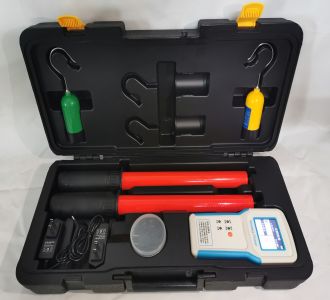

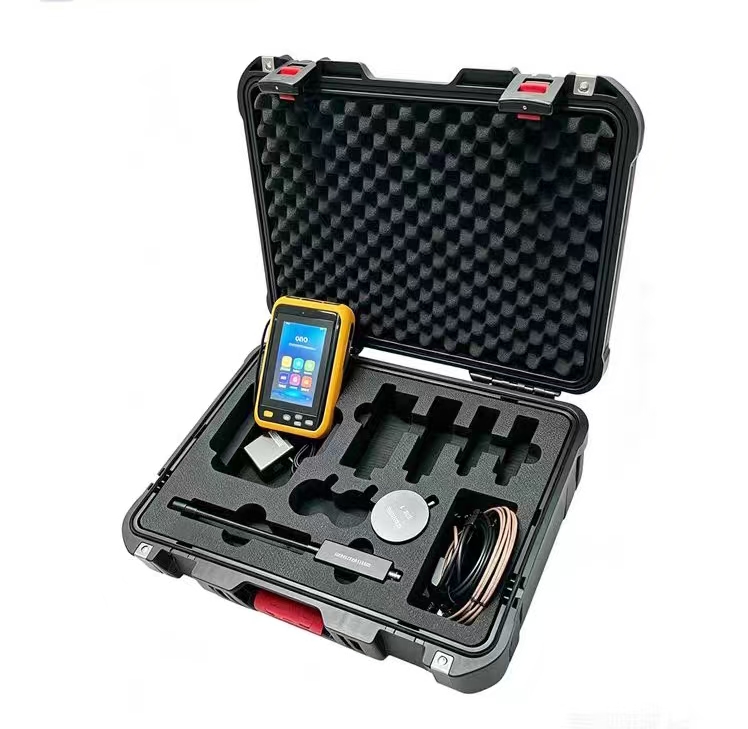
Dielectric Loss Tester
The dielectric loss tester (also known as "dissipation factor tester") is a specialized instrument used to measure the insulation performance of high-voltage electrical equipment, serving as a core tool for evaluating equipment insulation status in preventive tests of power systems.
Working Principle
Under the action of AC voltage, an ideal insulating medium should behave purely capacitively, with the current leading the voltage by 90°. However, actual insulating materials exhibit conductance loss and polarization loss, causing the angle by which the current leads the voltage to be less than 90°, forming a loss angle δ. The dielectric loss factor tanδ is the tangent of this loss angle.
Modern dielectric loss testers apply a sinusoidal voltage to the device under test, synchronously acquire voltage and current signals, and use discrete Fourier transform (DFT) or digital correlation algorithms to calculate the fundamental amplitude and phase difference, thereby obtaining tanδ and capacitance Cx.
Core Measurement Parameters
Dielectric loss factor (tgδ): Reflects the degree of deterioration of insulating materials. Pure, dry, and intact insulating materials have very small tgδ values; when insulation is damp, aged, cracked, or contains impurities, the tgδ value increases significantly, making it a sensitive indicator for judging insulation condition.
Capacitance (Cx): Reflects the overall structural state of insulating equipment. When damp, the capacitance value usually increases; when aged and dried out, it may decrease. For capacitive equipment (such as CVT, bushings), significant changes in capacitance may indicate serious defects such as internal component breakdown, short circuit, or open circuit.
Main Measurement Methods
Table
Download as table
Export as image
Method Principle Applicable Scenario
Automatic balanced bridge method Digital implementation of traditional Schering bridge principle Precision measurement in laboratories
Current comparison method Uses precision current transformers to compare the phase difference and amplitude ratio of currents between standard and tested capacitors Widely used in portable testers
Digital sampling method High-speed synchronous sampling of voltage and current signals, digital signal processing to calculate phase difference Mainstream solution for modern intelligent instruments
Variable frequency measurement method Uses off-frequency power supply (e.g., 45Hz/55Hz) to avoid 50Hz power frequency interference On-site measurement in strong electromagnetic interference environments
Instrument Classification
By measurement principle: automatic balanced bridge type, digital sampling analysis type, off-frequency measurement type
By structural form: integrated type, split type, portable type
By test voltage level: low voltage type, medium voltage type, high voltage type, ultra-high voltage/extra-high voltage type
Modern mainstream products are fully automatic anti-interference dielectric loss testers, with integrated structure, built-in standard capacitor and voltage boosting power supply, using variable frequency technology to automatically filter out power frequency interference, supporting both positive and reverse connection methods, and capable of outputting high voltages from 0.5kV to 10kV in different levels.
Typical Technical Parameters (using mainstream models as examples)
High voltage output: 0.5~10kV, increasing by 500V per step, ten steps in total
tgδ accuracy: ±(reading × 1.0% + 0.04%)
Cx accuracy: ±(reading × 1.0% + 5pF)
Measurement range: 0.1%<tgδ<50%, 3pF<Cx<60000pF
Variable frequency: 45Hz, 55Hz, 65Hz, etc.
Operating environment: -15℃~50℃, relative humidity <90%
Application Fields
Power transmission and transformation systems: insulation diagnosis of transformers, instrument transformers (PT/CT), high-voltage bushings, CVTs, coupling capacitors, surge arresters, high-voltage cables, and other equipment
Insulating oil testing: with dedicated oil cup and temperature control device, measure the dielectric loss factor of insulating oil to judge the degree of oil deterioration
Power generation enterprises: measurement of insulation loss of generator stator windings
Industrial and mining enterprises and rail transit: regular insulation testing of high-voltage distribution equipment
Scientific research and laboratories: development of new insulating materials, research on insulation aging mechanisms, fault case analysis
Core Value
Preventive testing: regular testing to establish data archives, longitudinal comparison of tgδ and Cx trends, even if values do not exceed limits, obvious increasing trends can detect potential defects in advance
Fault diagnosis: provides precise quantitative analysis, judges the cause and severity of insulation deterioration, providing decision-making basis for repair or replacement
Quality inspection: used for acceptance tests after new equipment warehousing and installation, ensuring equipment is in good condition when put into operation