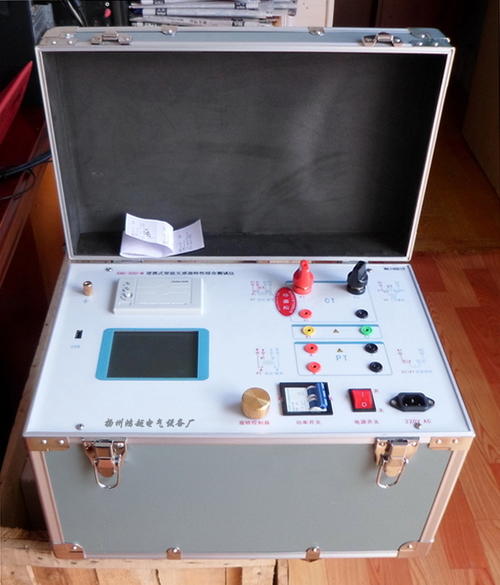

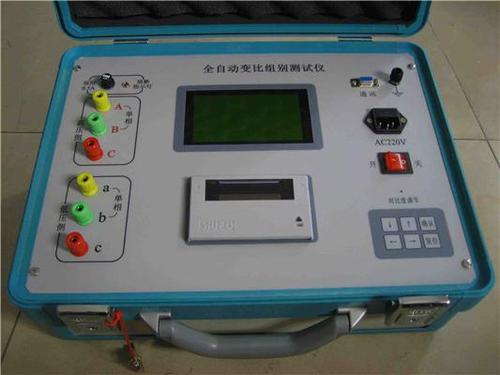
Transformer Turn Ratio Tester
A transformer turn ratio tester (also known as a ratio and phase group tester) is a specialized detection instrument used to accurately measure key parameters of power transformers, such as voltage ratio (turns ratio), connection group, and polarity. It is core equipment in factory inspection, acceptance testing, and preventive testing of transformers.
Working Principle
The instrument internally generates a stable three-phase (or single-phase) test power supply using digital synthesis technology, applies it to the high-voltage winding of the transformer, and simultaneously samples voltage signals on both the high-voltage and low-voltage sides. By comparison and calculation, it determines:
Turn Ratio: The voltage ratio between the high-voltage and low-voltage windings (K = U₁/U₂), reflecting whether the number of winding turns is correct.
Connection Group: The phase relationship between the high-voltage and low-voltage windings, identified using the clock notation (e.g., Yyn0, Dyn11, etc.).
Ratio Error: The percentage deviation between the measured ratio and the rated ratio on the nameplate.
Modern instruments use low-voltage and low-current testing methods, which are non-destructive to the transformer and ensure safe and reliable testing.
Main Technical Parameters
Table
Download as table
Export as image
Item Parameter
Ratio measurement range 0.9 to 10000
Ratio resolution 0.0001
Ratio measurement accuracy 0.1% to 0.5% (for different ranges)
Group detection range 0 to 11 points (corresponding to groups 1 to 12)
Phase angle resolution 0.01°
Phase angle measurement accuracy 0.1°
Power supply AC 220V±10% 50Hz, or built-in lithium battery
Operating temperature -5°C to 50°C
Ambient humidity ≤85% RH
Data storage 20 to 1000 groups, with power-off protection
Communication interface USB, RS232, some support Bluetooth
Core Functional Features
Fully automatic testing: With a single connection, it automatically completes measurement of three-phase ratio, group, error, tap position, and other parameters without manual calculation.
Blind testing: No need to know the transformer connection method or group in advance; the instrument automatically identifies them, and can even measure the ratio and group number of transformers without nameplates.
True three-phase testing: Internally synthesizes a three-phase standard sine wave signal source (distortion <0.1%, symmetry better than 0.05%), providing good equivalence of test results and avoiding group misjudgment.
Hexagonal vector diagram display: Results are displayed intuitively with numbers and hexagonal vector diagrams, facilitating judgment of the connection group.
Tap testing: Can quickly measure the ratio and error at each tap changer position; the rated ratio only needs to be entered once to automatically calculate deviations for all positions.
Phase angle measurement: Can accurately measure the phase angle between the high-voltage and low-voltage sides (0° to 360°), supporting measurement of ratio and angle for non-integral tap transformers.
Multiple protections: Includes high/low voltage reverse connection protection, output short-circuit protection, and overcurrent/overvoltage protection.
Data management: Built-in thermal printer, supports USB export, Bluetooth transmission, and host computer software management.
Product Forms
Table
Download as table
Export as image
Type Features Applicable Scenarios
Benchtop Comprehensive functions, large screen display, approximately 5-10 kg Laboratory testing, factory inspection of transformers
Portable AC/DC dual-use, built-in lithium battery, approximately 2-5 kg On-site acceptance testing at substations, preventive testing
Handheld Lightweight and compact (approximately 1.3-2 kg), can test more than 100 units continuously on a single charge On-site inspections, confined spaces
Typical Application Scenarios
Factory inspection: Ensure that the ratio and group of new transformers meet design requirements.
Acceptance testing: Verify that the ratio and group match system requirements before commissioning.
Preventive testing: Periodically check whether windings of transformers in operation have deformations, inter-turn short circuits, or other faults.
Tap changer testing: Measure the ratio at each tap position of on-load/off-circuit tap-changing transformers to verify that the switch operates correctly and contacts are good.
Parallel operation verification: Confirm that multiple transformers have consistent groups to prevent circulating currents that could cause short circuits during parallel operation.
Fault diagnosis: Conduct targeted testing when transformer winding defects are suspected.
Result Judgment Criteria
According to GB 1094 and related standards:
Rated tap: Voltage ratio allowable deviation is ±0.5%.
Transformers below 35kV with a ratio less than 3: Allowable deviation is ±1%.
Other taps: Allowable deviation is within 1/10 of the transformer impedance value (%), but must not exceed ±1%.
The connection group of three-phase transformers or the polarity of single-phase transformers must match the nameplate and terminal markings.
The sequence of voltage ratios at each tap should be consistent with the nameplate markings.
Applicable Standards
Table
Download as table
Export as image
Standard Number Name
DL/T 963-2005 Technical Conditions for Transformer Turn Ratio Testers
DL/T 911-2004 Guide for Power Transformer Testing
GB 1094 series Power Transformer Standards
IEC 76-1 / IEC 60044 Relevant IEC standards
Operating Points
Safety first: Strictly follow procedures for de-energizing, verifying no voltage, and installing grounding wires; confirm that the transformer is completely de-energized and has no residual voltage.
Correct wiring: Connect high-voltage terminals (A, B, C) to the high-voltage side of the transformer and low-voltage terminals (a, b, c) to the low-voltage side; reverse connection is strictly prohibited.
Parameter input: Correctly input rated high voltage, rated low voltage, connection group, total number of taps, and tap spacing.
Step-by-step testing: When adjusting the tap changer, wait for data to stabilize at each position before saving; skipping positions is strictly prohibited.
Reliable grounding: Both the instrument and the tested transformer casing should be reliably grounded.
Environmental requirements: Temperature not lower than 5°C, humidity not greater than 85% RH, and avoid strong electromagnetic interference.
Major Brands
Table
Download as table
Export as image
Category Brand Features
Domestic Huayi Electric BBC-V multifunctional type, supports testing of Z-type windings, rectifier transformers, and railway Scott transformers.
Domestic Musen Electric MS-100ES type, true three-phase testing, outstanding blind testing capability.
Domestic Yangzhou Guohua Electric Advantage in localized services.