

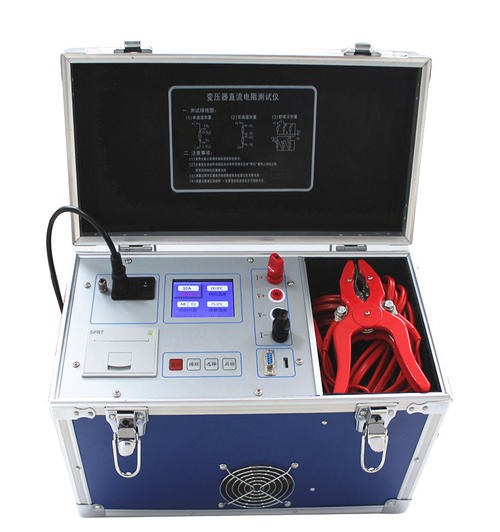
Loop Resistance Tester
The Loop Resistance Tester (also known as Contact Resistance Tester, English: Loop Resistance Tester) is a high-precision specialized instrument used to measure the contact resistance of conductive circuits in electrical equipment such as high-voltage switches, circuit breakers, disconnectors, and GIS combined appliances. It is a core testing tool in handover tests and preventive maintenance of power equipment.
Working Principle
It adopts the DC voltage drop method (four-wire method / Kelvin measurement method): a constant DC high current (usually ≥100A) is injected into the measured circuit through a current source, while a high-impedance voltage measurement circuit detects the voltage drop across the measured resistance. The resistance value is calculated according to Ohm's law R=U/I. The core advantage of the four-wire method is that it effectively eliminates the influence of the test lead's own resistance and contact resistance on the measurement results.
The high current (100A and above) serves to break through the oxide film and oil film on the contact surface, so that the measurement results truly reflect the actual contact state of the conductive circuit.
Main Technical Parameters
Table
Download as Table
Export as Image
Item Parameter
Test Current 50A, 100A, 150A, 200A, some models up to 400A/600A
Measurement Range 0-4mΩ (some models up to 0-2999.9μΩ)
Resolution 0.01μΩ
Accuracy Class 0.2, 0.5, or 1.0
Power Supply AC 220V±10% 50Hz, some handheld models support lithium battery power
Operating Temperature -10℃ to 50℃, humidity ≤90%RH
Data Storage 200-1000 sets, supports power-off protection
Communication Interface RS232/RS485 (Modbus-RTU), USB, some support Bluetooth
Core Features
High Current Output: Uses high-frequency switching power supply technology, capable of continuous high current output for extended periods, ensuring true contact resistance is obtained after breaking through the oxide film
High-Precision Measurement: Equipped with precision instrumentation amplifiers, high-precision quadruple integration A/D converters, and high-performance ARM chips
Intelligent Functions: Automatic range switching, automatic timing, automatic calculation of average values, temperature compensation to standard temperature, automatic alarm for out-of-limit values, and pass/fail judgment
Portable Design: Benchtop models weigh about 3-6.5kg, handheld models about 1.35-1.6kg, built-in lithium battery supports long-term outdoor use
Data Management: Built-in thermal printer, supports U-disk export to Excel files, some models support Bluetooth APP control and wireless data transmission
Product Forms
Table
Download as Table
Export as Image
Type Features Applicable Scenarios
Benchtop Comprehensive functions, stable high current output Substation maintenance, laboratory testing
Handheld Lightweight and compact, lithium battery powered On-site inspection, space-constrained situations
Single Clamp No auxiliary ground rod needed, directly clamp for measurement Quick ground circuit testing
Double Clamp Dual clamp coordinated measurement Complex grounding system testing
Typical Application Scenarios
High-Voltage Circuit Breakers: Contact resistance testing of moving/static contacts to determine if contact wear and contact pressure are normal
Disconnectors: Measurement of main circuit conductive contact resistance
GIS Combined Appliances: Resistance testing of main circuits in each bay
Busbars/Cable Joints: Contact resistance testing at connection points
Weld Quality Testing: Evaluating the electrical conductivity of welded joints
Motor Windings/Relay Contacts: Quick measurement of DC resistance
Implementation Standards
Table
Download as Table
Export as Image
Standard Number Name Status
DL/T 845.4-2019 General Technical Conditions for Resistance Measuring Devices Part 4: Loop Resistance Tester Current (replacing 2004 version)
JJG 1052-2025 Verification Regulation of Loop Resistance Testers Current (effective from December 11, 2025, replacing 2009 version)
JJG 1205-2025 Verification Regulation of DC Resistance Testers Current (effective from December 11, 2025)
GB 50150-2016 Standard for Handover Test of Electrical Equipment Installation Engineering Current
DL/T 596-2021 Regulations for Preventive Tests of Power Equipment Current
Result Judgment Method
To determine whether the loop resistance is abnormal, it is not advisable to simply use the rule of "below a certain fixed micro-ohm value". A more reliable method is:
Establish Baseline: Record the resistance value at initial commissioning as a reference
Longitudinal Comparison: For the same equipment under the same test conditions, if a certain phase's resistance continues to rise relative to the historical baseline, further inspection should be arranged
Horizontal Comparison: If there are obvious differences among the three phases, check the contact pressure, connectors, flexible connections, and clamp contact conditions
Repeatability Verification: If repeated measurements of the same phase show large fluctuations, first confirm the wiring and instrument stability
Major Brands
Table
Download as Table
Export as Image
Category Brand Features
Imported Megger Covers full range from 10A to 600A, emphasizes field portability and data repeatability
Imported DV Power RMO series micro-ohmmeters, CAT series integrated circuit breaker comprehensive diagnostics
Imported AEMC/Chauvin Arnoux Covers 10A/200A levels, emphasizes low-resistance measurement methods and data management
Domestic Beijing Kanggaote (KGT) Baiju Pro handheld, 0-300A smooth adjustment, battery powered
Domestic Yangzhou Guohua Electric Advantage in localized service, adapted to domestic power testing procedures
Domestic Wuhan Ultra-High Voltage Electric Professional manufacturer of power testing equipment