

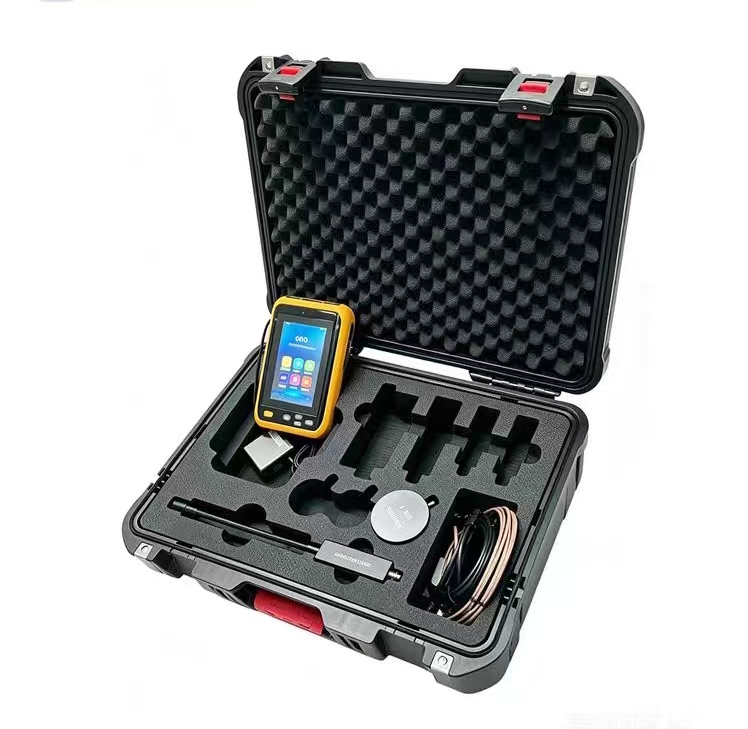
High-Voltage Wireless Phase Tester
The high-voltage wireless phase tester (also known as a wireless phase comparator or high-voltage voice phase tester) is a specialized device used for phase verification and phase sequence verification of power lines and substations. It uses wireless transmission technology to compare phases between two or more measurement points without physical wiring, offering high safety and convenient operation.
Basic Composition
The device typically consists of the following parts:
Collectors (detectors/transmitters): Two units, X and Y, responsible for collecting phase signals from the conductor under test, with built-in wireless transmission modules
Receiver (host): Equipped with an LCD screen, receives two signal channels and performs phase comparison, displaying the phase verification result
Insulated telescopic pole: Made of epoxy resin, used to bring the collectors close to the high-voltage conductor; retracted length approximately 600–670mm, extended length approximately 3000–3200mm
Accessories: USB communication cable, data upload software, charging device, self-calibration cable, etc.
Working Principle
Signal acquisition: When the collector approaches or contacts a live conductor, an alternating electromotive force is induced internally through electromagnetic induction, extracting the phase signal
Wireless transmission: After processing, the collector transmits the phase signal to the host via radio frequency (315MHz, 433MHz, or 2.4G frequency hopping, etc.)
Phase comparison: The host simultaneously receives the X and Y signals, calculates the phase difference, and determines whether they are in phase or out of phase
Result output: Displays the phase angle and vector diagram on the LCD screen, while voice broadcasting "in phase" or "out of phase"
Core Functions
Phase verification: Determines whether two lines or different nodes on the same line are in phase
Voltage detection: Detects whether a conductor is live, with automatic audible and visual alarm when exposed to a strong electric field
Phase sequence measurement: Determines positive phase sequence (120°) or negative phase sequence (240°)
Frequency measurement: Range 45.0Hz–65.0Hz
Phase measurement: Range 0°–360°, resolution 1°
Transformer group analysis: Identifies wiring group differences (e.g., when a 30° or 60° phase difference occurs)
Phase verification voltage range 10V–500kV (some models up to 550kV)
Wireless transmission distance (line of sight) 100–200m, some models up to 1600m
Long-distance satellite phase verification GPS/BeiDou timing, distance ≥500km
In-phase determination criterion Phase difference ≤30° (some models within ±20°)
Out-of-phase determination criterion 100°–140°, 220°–260°
Self-calibration error ≤±3°
On-site in-phase error ≤±7°
On-site out-of-phase error ≤±12°
Sampling rate 3 times/second
Insulated pole withstand voltage ≤110kV (standard pole), ≤220kV (extended pole)
Operating temperature -35℃–+50℃
Operating humidity ≤95%RH
Data storage 200 groups, USB upload
Usage Instructions
Self-check before use
Insert the self-calibration cable into a 220V power source, connect both ends to the X and Y collector probes respectively; the host should display "in phase" or a phase difference of 0°/360°. Alternatively, hang both collectors on the same high-voltage line for self-calibration.
Phase verification operation
Contact phase verification: Suitable for bare conductors below 35kV or conductors with insulated sheathing below 110kV; the collector probe hook directly contacts the conductor
Non-contact phase verification: Suitable for bare conductors above 35kV; gradually bring the collector close to the conductor (for 110kV–220kV, place 300–1000mm below the conductor; for 500kV, place 1000–2000mm below), and phase verification is completed once the electric field signal is sensed, without contact
Result determination
In phase: Displays phase difference 0° or 360°, voice prompt "in phase"
Out of phase: Displays 120° (positive phase sequence) or 240° (negative phase sequence), voice prompt "out of phase"
Special groups: If AA′, BB′, and CC′ all display out of phase with a 30° or 60° phase difference, it is caused by different transformer wiring groups
Main Application Areas
New construction/renovation of substations: Phase determination and verification before connecting new lines to the grid
Grid interconnection: Confirming phase consistency before parallel operation of two lines
Distribution line maintenance: Verifying phase sequence correctness after switching operations
Central switchgear/ring main units: Synchronous detection of six phases inside switchgear
Railway/metallurgy/chemical industry: Phase verification of high-voltage power supply systems
Safety Precautions
Operators must work in accordance with the high-voltage testing safety distance standards of the power department and hold relevant certificates
The insulated pole must undergo a withstand voltage test before first use and annually thereafter
When line voltage exceeds 110kV, non-contact phase verification must be used; direct contact is strictly prohibited
Remove collector batteries when not in use for a long time; replace them at least once a year
Store the device in a dry, ventilated environment, avoiding high temperature, humidity, and dust
Precision instruments must not be disassembled at will; although compliant with EMC electromagnetic compatibility standards, they should still be kept away from extreme interference sources
The device complies with standards such as IEC60855, GB13398-2008, DL/T971-2005, etc.
Selection Recommendations
Conventional distribution (≤35kV): A standard model is sufficient, using contact phase verification, with low cost
High-voltage transmission (110kV–500kV): Choose an intelligent model supporting non-contact phase verification, equipped with a true-color LCD screen and voice prompts
Cross-regional/long-distance phase verification: Choose a model with GPS/BeiDou satellite timing function, capable of measuring phase differences over hundreds of kilometers
Need for records and archiving: Choose a model with data storage and USB upload functions