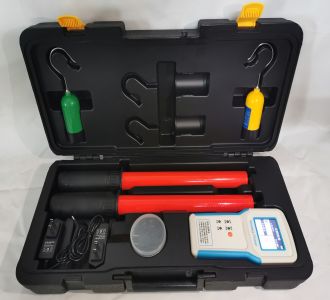

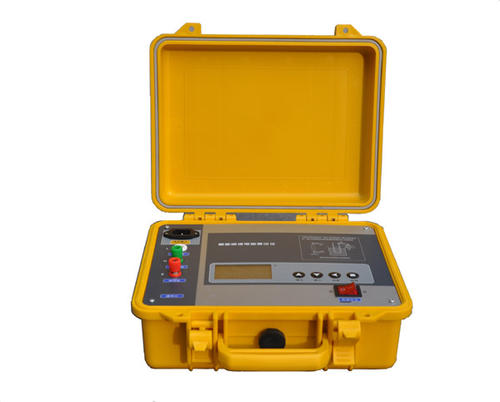
High-Voltage Wireless Phase Sequence Tester
The high-voltage wireless phase sequence tester is a core safety tool used in power systems for phase verification, voltage presence detection, and phase sequence measurement. It is mainly used for phase verification and phase sequence verification of power lines and substations, preventing accidents such as short circuits, motor reversal, or equipment damage caused by phase errors.
Combined with the latest industry data and selection logic, here is a practical procurement and usage guide for you:
I. Core Functions and Technical Principles
The high-voltage wireless phase sequence tester usually consists of a transmitter (collector/detector), a receiver (host), and an insulated telescopic rod.
Working principle: Based on the principle of electromagnetic induction, when the detector approaches a high-voltage conductor, an alternating electromotive force is induced. After processing, it is wirelessly transmitted to the host through a radio channel (such as 315MHz, 433MHz, or 2.4G frequency hopping). The host performs phase comparison and determines the result.
Multi-function integration: In addition to the core phase verification function, it also has functions such as high-voltage voltage detection, phase sequence measurement (positive/negative phase sequence), frequency measurement, and transformer group analysis.
Intelligent prompts: Modern intelligent phase sequence testers are equipped with true-color LCD screens (which can display vector diagrams, phase angles, etc.) and voice broadcast functions (such as "X/Y signal normal," "same phase," "different phase," "positive phase sequence," etc.), greatly reducing the threshold for on-site operation.
II. Core Selection Parameters: 5 Hard Indicators That Must Be Checked
Voltage Level and Phase Verification Method
Coverage range: Current mainstream products cover 10V~500kV (or 550kV).
Distinction of phase verification methods: Lines of 35kV and below support contact phase verification (direct contact with bare conductors or phase verification on insulation); above 35kV (or above 110kV) must use non-contact phase verification, gradually approaching the detector to the conductor to sense the electric field signal without direct contact, ensuring personnel safety.
Wireless Transmission Distance and Timing Technology
Conventional distance: The line-of-sight wireless transmission distance is usually between 100 meters and 200 meters, supports wall penetration, and is sufficient for most substations and switchgear scenarios.
Long-distance cross-region phase verification: If long-distance transmission line verification is involved, models supporting GPS/Beidou satellite timing technology need to be selected, which can achieve phase difference measurement of ≥500km.
Measurement Accuracy and Error
Phase resolution is usually 1°, and the sampling rate is 3 times/second.
On-site same-phase error is generally ≤±7° (or ≤10°), and different-phase error is ≤±12° (or ≤15°); high-precision models can achieve self-calibration error of ≤±3°.
Insulation Rod Withstand Voltage Level
The insulation rod must match the voltage being tested. When the conventional insulation rod is 600mm retracted and 3200mm extended, the withstand voltage level is usually ≤110kV; if testing 220kV lines, a longer insulation rod (such as 8 meters) must be customized or selected, and the rod body with the built-in antenna in the first section is strictly prohibited from undergoing withstand voltage tests.
Data Management and Protection
Preferably choose models equipped with a USB communication interface, supporting storage of more than 200 sets of data and PC-side data management.
The host and collector should have electromagnetic interference (EMC) resistance, adapt to complex substation environments, and automatically sound and light alarm when exposed to strong electric fields.
III. Recommended High-Quality Manufacturers in Yangzhou and Surrounding Areas
Yangzhou (especially Baoying County) is an important industrial belt for power testing instruments in China, with mature supporting facilities and convenient procurement:
Yangzhou Xinbo Electric Technology Co., Ltd.: Located in Liubao Industrial Concentration Zone, Baoying County, mainly engaged in wireless phase sequence testers and mining cable flame-retardant materials, with enterprise production and processing qualifications.
Yangzhou Jufeng Electric Co., Ltd.: Located in Yangzhou City, supplying wireless high-voltage phase sequence testers/high-voltage wireless phase sequence testers. Products support customization for voltage levels from 0.38kV to 220kV and above, with voice broadcast and true-color screen display functions.
Yangzhou Zhili Electric Technology Co., Ltd. / Yangzhou Hengwei Electric Heating Technology Co., Ltd.: In addition to mainly engaged in electric heaters, these two companies also have the supply capacity for high-voltage testing instruments, suitable for customers with comprehensive supporting procurement needs of "heating + testing."
IV. Safe Operation and Daily Maintenance Specifications
On-Site Operation Points
Safety protection: Operators must wear insulated protective equipment and strictly comply with the high-voltage testing safety distance standards of the power department (such as 10kV line safety distance ≥0.7m, 35kV ≥1m).
System self-calibration: Self-calibration must be performed before on-site testing. Connect the X and Y collectors to the same phase power source (or connect to 220V mains for verification), confirm that the instrument displays "same phase" and the error is within the allowable range.
Non-contact operation: When performing phase verification on bare conductors above 35kV, the metal probe of the detector can be 300mm-2000mm away from the conductor. After sensing the signal, keep it still and read the data.
Maintenance and Care
Battery management: When not in use for a long time, be sure to remove the collector battery to prevent leakage from damaging the equipment; the X/Y collector batteries need to be replaced at the same time, and the power of the host and collector needs to be checked regularly.
Withstand voltage test: The insulation rod is a safety tool. Before first use and annually, it must undergo a withstand voltage test in accordance with the "Preventive Test Regulations for Electric Power Safety Tools."
Storage environment: Precision instruments are prohibited from being disassembled at will. Store in a dedicated box that is dry, ventilated, and avoids high temperature, humidity, and dust.