

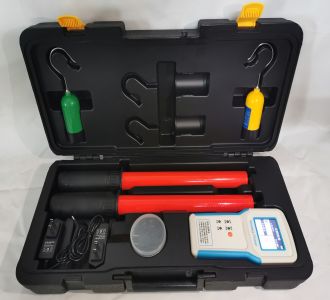
High-Voltage Wireless Phase Sequence Tester
The high-voltage wireless phase sequence tester is the "stabilizing anchor" before power system switching operations, line grid connection, and dual-power supply switching. It is mainly used to verify whether the phases of two high-voltage lines or different power source points are consistent, preventing serious short-circuit accidents or equipment damage caused by phase errors.
Based on your daily attention to the selection and procurement of power testing instruments, the following summarizes its core principles, selection pitfalls avoidance guide, and procurement suggestions for surrounding manufacturers.
Core Principles and Structure
The wireless phase sequence tester has completely eliminated the long lead wire of traditional wired phase sequence testers, which is extremely prone to tangling and carries the risk of induced electricity. It usually consists of two transmitters (collectors/detectors), one receiving host (display), and insulated telescopic rods.
Its working principle is based on electric field induction and wireless transmission technology: the detector obtains voltage signals from high-voltage conductors through high-voltage capacitive voltage division or electric field induction principles. After filtering, amplification, shaping, and other processing, it sends phase information with precise timestamps to the receiving host via radio waves (such as 315MHz, 433MHz, or 2.4G frequency hopping). The host aligns the waveforms according to the timestamps and calculates the phase difference angle between the two voltage signals to determine whether they are in phase or out of phase.
Key Parameter Guide for Selection
When selecting for procurement, it is recommended to focus on verifying the following four dimensions of parameters to match actual working conditions:
Voltage Level and Phase Verification Method (Determines the Safety Bottom Line)
Voltage Adaptation: The rated voltage of the phase sequence tester must be equal to or higher than the maximum working voltage of the system under test. Current mainstream models have achieved wide-range adaptive design (such as 10V~500kV), eliminating the need to purchase multiple sets of equipment according to voltage levels.
Phase Verification Method: For bare conductors of 35kV and below, contact measurement can be used; for 35kV and above, non-contact measurement must be used (the detector gradually approaches the conductor to sense the electric field signal), without direct contact with high-voltage conductors, making it safer.
Wireless Transmission and Anti-Interference (Determines On-Site Success)
Transmission Distance: The line-of-sight transmission distance for conventional short-range phase verification is usually between 100 meters and 200 meters, and must meet the needs of substation layout and obstacle penetration.
Remote Phase Verification: If long-distance transmission lines are involved, models equipped with GPS/Beidou satellite timing technology should be selected. Through microsecond-level clock synchronization, phase difference measurement within hundreds of kilometers (such as 500km or even 800km) can be achieved.
Anti-Interference: In strong electromagnetic field environments (such as near transformers and busbars), products using digital encoding, frequency hopping, or high signal-to-noise ratio design should be selected to prevent misjudgment.
Measurement Accuracy and Functions (Determines Data Credibility)
Phase Accuracy: The phase difference error is generally required to be ≤5° (some high-precision models have self-calibration error ≤±3°). The judgment standard is usually that a phase difference ≤±15° (or ±30°) is regarded as in phase, and greater than this threshold is regarded as out of phase.
Multifunctional Integration: Modern phase sequence testers usually integrate functions such as high-voltage voltage detection, phase sequence judgment, frequency measurement, and transformer vector group analysis.
Intelligent Interaction: Models with real-person voice prompts (such as "phases are the same," "caution, phases are different"), true-color LCD screens displaying vector diagrams, and support for USB/Bluetooth data export to generate reports are preferred, greatly reducing manual entry errors.
Safety and Protection Performance (Determines Personnel Safety)
Insulation Strength: The insulating rod must pass power-frequency withstand voltage and impulse withstand voltage tests corresponding to the voltage level, and comply with standards such as DL/T 971.
Protection Design: For outdoor use, a protection rating of IP65 or above is recommended, with safety designs such as power-on self-test, low battery indication, signal loss alarm, anti-mis-touch, and automatic power-off.
Common Models and Surrounding Manufacturers Reference
Common wireless high-voltage phase sequence tester models on the market include the TAG-8000 series, WHX series, GWH series, ETCR1500, etc.
In terms of procurement channels, China's power testing instrument industry belt is mainly concentrated in two major regions: Yangzhou/Baoying in Jiangsu and Wuhan in Hubei.
Surrounding Jiangsu (Yangzhou, Baoying, Shanghai, etc.): A large number of high-voltage testing equipment manufacturers are gathered here. For example, Jiangsu Jiuyi Electric in Yangzhou (GWH series, using 2.4G frequency hopping technology, strong anti-interference), and Baoying's Gaodian Electric Power Equipment Manufacturing Plant (GDHX series, modular voltage-dividing probe design). In addition, the Shanghai area also has manufacturers such as Shanghai Taiyi Electric and Shanghai Liubao Electric with full-type test capabilities in CNAS-certified laboratories. These manufacturers are relatively close to you, making localized service response and after-sales maintenance more convenient.
Wuhan, Hubei: As a traditional important town for power equipment research and development, it has many brands such as Wuhan Hongzhi Gaoche (relatively high market share, patent for resistance to high-voltage corona interference), Wuhan Guodian Xigao, Wuhan Moen Intelligent Electric, and Wuhan Zhuoya Electric. Their product lines usually cover a complete sequence from basic models to ultra-high-voltage intelligent models.
It is recommended that during actual procurement, you directly clarify to the manufacturer your main voltage level under test, whether remote GPS phase verification is needed, and whether there are specific data export format requirements. Ask them to provide detailed selection drawings and third-party metrological calibration certificate templates to ensure the equipment passes acceptance smoothly.