

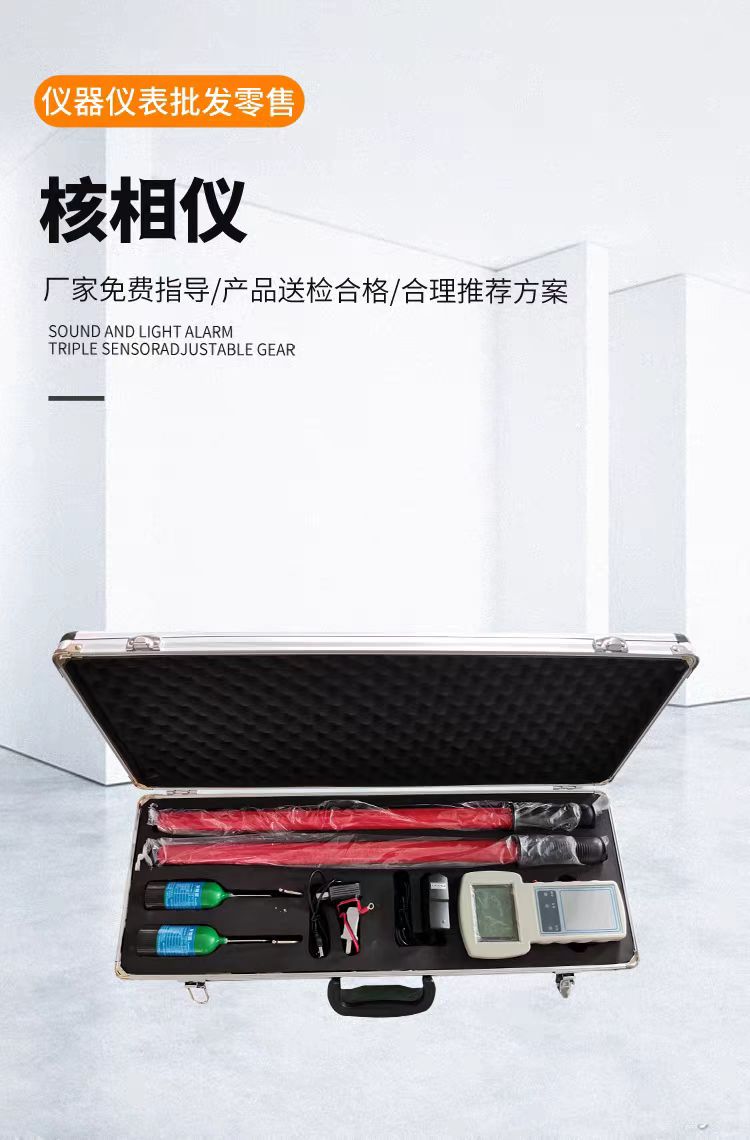
Online Partial Discharge Tester
An online partial discharge tester (also known as an online partial discharge detection instrument or online partial discharge monitoring system) is a professional instrument that performs real-time monitoring and diagnosis of the internal insulation condition of electrical equipment while it remains energized and in operation. It is one of the core tools for the power system's transition from "periodic maintenance" to "condition-based maintenance."
What is Partial Discharge
Partial Discharge (PD) refers to a non-penetrating discharge phenomenon occurring in localized areas of an insulation system. When insulation materials gradually deteriorate due to thermal aging, electrical aging, or environmental factors, the local electric field strength may exceed the insulation withstand level, resulting in discharge. In the early stages, partial discharge often has no obvious external manifestations and is difficult to detect through traditional inspection methods. However, prolonged continuous discharge will continuously erode the insulation structure and may eventually lead to phase-to-phase short circuits or ground faults.
Main Detection Technologies
Online partial discharge testers typically employ a combination of multiple detection technologies, enhancing monitoring accuracy and reliability through signal complementarity:
Table
Download as Table
Export as Image
Detection Method Principle Features
Ultra-High Frequency (UHF) Method Captures electromagnetic wave signals in the 300MHz~3GHz frequency band Strong anti-interference capability, high sensitivity, suitable for detecting internal discharges
Acoustic Emission (AE) Method Collects mechanical vibration signals of 20kHz~200kHz generated by discharge Good detection effect for surface discharges and corona discharges, resistant to electromagnetic interference
Transient Earth Voltage (TEV) Method Monitors millivolt-level transient voltages on the switchgear enclosure Easy installation, no power outage required, suitable for switchgear
High-Frequency Current Transformer (HFCT) Method Detects pulse currents on grounding wires through high-frequency current transformers Non-invasive installation, suitable for cables, transformers, etc.
System Architecture
Online partial discharge monitoring systems typically adopt a four-layer architecture design: "Sensing Layer - Transmission Layer - Analysis Layer - Application Layer":
Sensing Layer: Deploys composite sensor arrays (UHF, AE, TEV, HFCT, etc.), using magnetic or rail-mounted non-invasive installation without altering the electrical characteristics of the equipment
Transmission Layer: Supports multiple communication methods such as RS485, Ethernet, LoRa, and 4G/5G, ensuring stable data transmission in complex electromagnetic environments
Analysis Layer: Equipped with a discharge pattern recognition engine based on deep learning, automatically distinguishing partial discharges from corona interference, switching operation noise, etc.
Application Layer: Through the monitoring platform, it achieves equipment health index assessment, graded alarms, trend prediction, and remote operation and maintenance management, supporting both Web and mobile viewing
Key Technical Parameters (Using a Typical Product as an Example)
Taking TBEA's PDP-SMART portable intelligent partial discharge online detection system as an example:
Table
Download as Table
Export as Image
Parameter Technical Specification
Detection Channels 3-channel synchronous measurement (single channel optional)
Detection Frequency Band 100kHz~100MHz
Detection Range 1pC~20nC (or equivalent mV value)
Sampling Rate 200MS/s
Detection Sensitivity ≤0.5pC (under laboratory conditions)
Inter-channel Synchronization Time ≤1ns
PD Location Accuracy ≤1 meter
Phase Accuracy ≤0.1°
Operating Ambient Temperature -20℃~+50℃
Applicable Equipment
Online partial discharge testers are suitable for insulation condition monitoring of various high-voltage electrical equipment:
Power Transformers: Monitoring the insulation condition of windings and bushings
GIS/GIL: Gas-insulated switchgear and gas-insulated lines
Power Cables: Live detection of 66~500kV cable lines
Switchgear: Real-time monitoring of complete distribution equipment
Generators/Motors: Insulation monitoring of stator windings
Instrument transformers, reactors, bushings, etc.
Common Products and Brands
Table
Download as Table
Export as Image
Brand/Product Type Features
OMICRON MONTESTO 200 Mobile temporary online monitoring IP65 protection, plug-and-play, supports remote access and email alerts
OMICRON UHF 800 Ultra-high frequency partial discharge measurement system 100~2000MHz, supports multi-channel synchronous measurement
Megger ICMmonitor Permanent online monitoring Integrated spectrum analyzer + acoustic detection + PD monitoring in one
TBEA PDP-SMART Portable intelligent detection system Strong edge computing capability, suitable for 66~500kV cables
Fankeste MEJFD-1000 Online partial discharge detector Maximum sampling rate of 20M, suitable for transformers, cables, etc.
Implementation Standards
GB/T 7354 "Partial Discharge Measurements"
DL/T 417 "Guide for On-site Partial Discharge Measurements of Power Equipment"
DL/T 1430 "Common Technical Requirements for High-Voltage Switchgear and Controlgear Standards"
GB/T 16927 "High-Voltage Test Techniques" series of standards
Selection Key Points
Detection Technology Combination: Select appropriate sensor combinations based on the type of equipment under test. For switchgear, prioritize TEV+UHF; for transformers, prioritize UHF+AE+HFCT
Monitoring Method: Permanent online monitoring (fixed installation) vs. temporary online monitoring (portable). The former is suitable for long-term monitoring of critical equipment, while the latter is suitable for inspections and fault troubleshooting
Sensor Performance: Focus on frequency response range, sensitivity, and signal-to-noise ratio
Communication Method: Choose wired (RS485/Ethernet/fiber optic) or wireless (LoRa/4G/5G) solutions based on site conditions
Software Features: Whether it supports PRPD spectrum analysis, trend prediction, automatic alarms, and remote access
Combined with the insulation resistance tester you previously learned about, the two complement each other in electrical equipment testing—the insulation resistance tester is used for offline detection of insulation resistance values, while the online partial discharge tester is used for real-time monitoring of early signs of insulation deterioration during energized operation. If you have a specific application scenario (such as transformers, switchgear, or cables), you can let me know, and I can help you further refine the selection plan.