

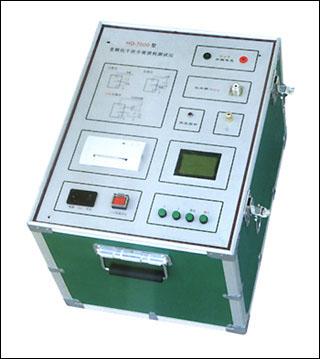
Online Partial Discharge Tester
An online partial discharge (PD) tester typically refers to a switchgear PD online monitoring system or a high-voltage cable/transformer/GIS PD online monitoring system. Unlike portable inspection instruments, it is fixedly installed at critical parts of equipment, capable of continuously collecting partial discharge signals 24/7 and assessing insulation health status in real time. It is a core tool for transitioning power equipment from "periodic maintenance" to "condition-based maintenance."
Core Working Principle
Modern online PD monitoring systems generally adopt multi-modal sensing fusion technology, where multiple sensors work collaboratively to complement each other, enhancing detection accuracy and anti-interference capability:
Ultra-High Frequency (UHF) Method: Detects electromagnetic wave signals in the 300MHz-3GHz frequency band. It has strong anti-interference capability and high sensitivity to minor defects (such as burrs, air gaps) inside GIS and transformers, making it the mainstream method for online monitoring of metal-enclosed equipment.
Transient Earth Voltage (TEV) Method: Detects transient voltage pulses (3-100MHz) induced on the surface of metal enclosures by internal discharges in switchgear. Sensors are attached to the enclosure surface for non-contact measurement, making it a standard feature for switchgear online monitoring.
Acoustic Emission (AE) Method: Detects mechanical vibration waves in the 20-300kHz frequency band. It has outstanding immunity to electromagnetic interference and is often used to assist UHF or TEV for acoustic-electric joint localization to confirm discharge points.
High-Frequency Current Transformer (HFCT) Method: Installed on cable grounding wires or equipment grounding down conductors via clamp-on sensors, coupling pulse current signals of 3-30MHz. It is particularly effective for PD detection in cables and rotating machines, as signals can propagate over long distances along cables.
The system performs synchronous acquisition, pattern recognition (such as PRPD/PRPS phase-resolved analysis), and trend prediction on multi-channel signals through backend software, automatically distinguishing real PD from external interference and issuing graded alarms upon anomalies.
Main Functions and Features
Real-time Online Monitoring: Continuous 24/7 acquisition captures transient discharge signals, filling the periodic blind spots of offline detection.
Intelligent Diagnostic Analysis: Built-in AI or expert systems automatically identify discharge types (such as corona, floating, or void discharges) and assess defect severity.
Graded Alarm Mechanism: Supports multiple strategies such as threshold alarms and trend alarms, notifying maintenance personnel via sound/light, SMS, APP push, or backend pop-ups.
Data Management and Traceability: Automatically stores historical data, waveform patterns, and alarm events, supporting generation of trend analysis reports to provide data support for equipment condition assessment and maintenance decisions.
Remote Operation and Maintenance: Supports various communication methods such as 4G/5G, fiber optics, and LoRa, enabling remote data viewing, parameter configuration, and software upgrades, reducing on-site maintenance costs.
Non-invasive Installation: Sensors are mostly installed via magnetic suction, clamping, or DIN rail mounting, without altering the original electrical and mechanical structure of the equipment, ready to use upon installation.
Main Application Scenarios
Table
Download as Table
Export as Image
Application Equipment Core Monitoring Methods Typical Scenarios
High-Voltage Switchgear TEV + UHF + AE 10kV/35kV switchgear in distribution rooms, ring main units, and industrial plants; monitors insulation aging, poor contact, moisture, and other defects.
Gas-Insulated Switchgear (GIS) UHF + AE Substation GIS busbars, circuit breakers, and disconnectors; precisely locates internal conductor burrs, free particles, and insulator surface discharges.
High-Voltage Power Cables HFCT + AE + UHF Joints and terminations of cables in tunnels, cable trenches, and direct burial; monitors insulation defects, water tree aging, and construction damage.
Power Transformers/Reactors UHF + AE + HFCT Transformer bodies, bushings, and tap changers; monitors discharge faults in windings, cores, and insulating oil.
Major Manufacturers and Selection Recommendations
There are many manufacturers of online PD monitoring systems in the market. Selection should consider technical strength, product maturity, and after-sales service.
Representative Domestic Manufacturers:
NARI Technology, XJ Electric, Sifang Jibao: Leading enterprises in the power automation field, providing complete solutions from monitoring hardware to condition assessment software, with strong system integration capabilities.
Beijing Kanggaote: Rich product line; its "Nezha" and "Jinzha" series are deployed in both portable and online monitoring fields, with multi-modal fusion and localized services as main advantages.
Jiangsu Fenggong Electric, Shanghai Moke Electronics: Focus on GIS and switchgear PD monitoring, with technical accumulation in signal algorithm recognition and anti-interference.
CSG Technology, Pinggao Group: Leveraging power grid backgrounds, their products better align with the operating regulations and acceptance standards of China Southern Power Grid or State Grid.
International Well-Known Brands:
Siemens Energy, Hitachi Energy: Provide high-end UHF online monitoring systems and SF6 gas decomposition product synchronous monitoring solutions, with leading technology but higher costs.
OMICRON (Austria): Known for high precision and traceability; its PD measurement uncertainty can be controlled within ±5%, suitable for scenarios requiring extremely high data accuracy.
PDS (UK): Deep expertise in TEV and ultrasonic technologies, with stable and reliable products.
Key Selection Considerations:
Scenario Matching: Clarify whether it is for switchgear, GIS, or cables; different equipment requires different optimal combinations of monitoring methods.
Anti-Interference Capability: The on-site electromagnetic environment is complex; evaluate the equipment's hardware filtering, software algorithms (such as wavelet denoising, pulse grouping), and actual anti-interference performance.
Data and Software: Does it support PRPD/PRPS patterns, AI defect recognition, and trend analysis? Can data be easily exported and integrated into existing production management systems (PMS)?
Communication and Protocols: Does it support standard protocols such as IEC 61850 and Modbus for easy integration with substation automation systems?
Service and Maintenance: The manufacturer's technical support response speed, calibration services, software upgrade policies, and spare parts supply directly affect the long-term availability of the system.
Standards Compliance: Confirm whether the product complies with relevant national and industry standards such as GB/T 7354, DL/T 1430, and IEC 60270.