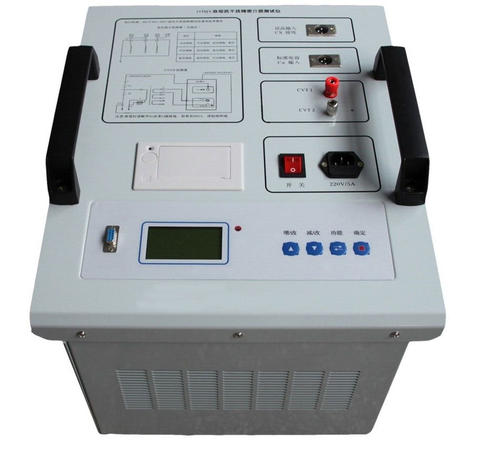

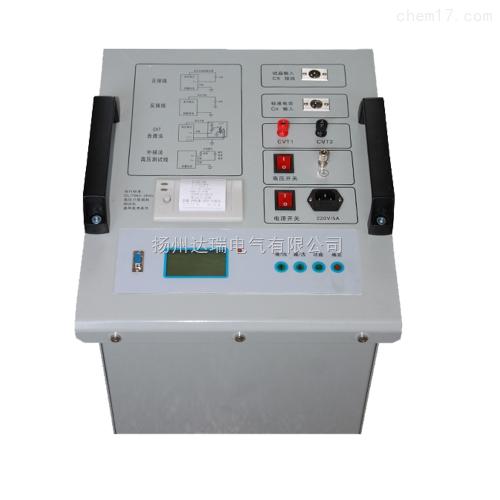
Dielectric Loss Tester
The dielectric loss tester (abbreviated as "tan delta tester") is a specialized instrument used to measure the dielectric loss tangent (tanδ) and capacitance (Cx) of the insulation of high-voltage electrical equipment. It is a core testing tool in the insulation condition assessment and preventive testing of power equipment.
Working Principle
The core principle of the dielectric loss tester is the vector operation method: the internal inverter generates a sinusoidal test high voltage, which is applied to the test object and the built-in standard capacitor. The high-precision acquisition circuit synchronously measures the amplitude and phase difference of the two current signals. Using digital signal processing (DSP) and fast Fourier transform (FFT) technology, the capacitance value (Cx) and dielectric loss tangent (tanδ) of the test object are calculated in real time.
Among them, the dielectric loss factor (tanδ) is defined as the ratio of active power to reactive power in the insulating medium (tanδ = P/Q), reflecting the degree to which electrical energy is converted into heat energy in the insulating material under an alternating electric field. It is a key parameter for evaluating insulation condition.
To cope with strong electromagnetic interference on site, modern tan delta testers generally adopt frequency conversion anti-interference technology, outputting non-power-frequency sine waves such as 45Hz/55Hz, combined with digital filtering and phase-shifting/reversal methods, to effectively filter out 50Hz power frequency interference.
Main Types
Table
Download as Table
Export as Image
Type Features Applicable Scenarios
Fully Automatic Anti-Interference Tan Delta Tester Integrated design, built-in high-voltage source and standard capacitor, frequency conversion anti-interference, easy operation On-site preventive testing in substations and power plants
Schering Bridge Classic method, requires manual balancing, high accuracy but complex operation Precision measurement in laboratories
Dielectric Constant/Loss Tester Broadband testing (20Hz~160MHz), equipped with three-electrode system and temperature control module Research on insulating materials, dielectric performance studies of films/ceramics, etc.
High-Frequency Q Meter Based on resonance method, high test frequency Material science research
High-Precision Measurement: tanδ resolution up to 0.01%, measurement error can be controlled within ±(1% reading + 0.04%), sensitively reflecting early insulation defects
Strong Anti-Interference Capability: Uses frequency conversion technology (45Hz/55Hz/65Hz, etc.), obtaining reliable data even in strong electric field environments of substations
Multiple Test Modes: Supports positive connection method (for testing ungrounded test objects), reverse connection method (for testing grounded test objects), CVT self-excitation method, external high-voltage method, etc.
CVT Special Function: One-time wiring can simultaneously measure the capacitance and tanδ of C1 and C2, supporting measurement without disconnecting high-voltage leads
Comprehensive Safety Protection: Equipped with grounding detection (voltage boost locked if not grounded), high-voltage short-circuit/overcurrent protection, electric shock protection, emergency stop, etc.
Integrated and Portable: Built-in step-up transformer, standard capacitor, and frequency conversion power supply, no external equipment needed, weight about 18~30kg
Preventive Testing of Power Equipment: Insulation condition detection of high-voltage equipment such as transformers, instrument transformers, bushings, capacitors, arresters, power cables, etc.
Commissioning Tests: Insulation performance acceptance of newly installed equipment before operation
CVT Testing: Measurement of dielectric loss and capacitance of capacitive voltage transformers, as well as ratio testing
Insulating Oil Testing: Measuring the dielectric loss of transformer oil with standard oil cup and temperature control device
Material Research: Analysis of dielectric constant and loss characteristics of insulating films, ceramics, plastics, and other materials
Railway Traction Power Supply System: Insulation testing of traction transformers and other equipment
🛒 Purchasing Points
Key Parameters:
Output Voltage Range: Common 0.5kV~10kV with multiple adjustable gears, some models support external high voltage exceeding 10kV
Measurement Accuracy: tanδ error recommended to be better than ±(1% reading + 0.04%), Cx error better than ±(1% reading + 5pF)
Measurement Range: Under internal voltage, capacitance generally covers 3pF~60000pF; under external voltage, it can reach above 10μF
Anti-Interference Capability: Confirm whether it has frequency conversion anti-interference function, and pay attention to the output frequency points of the different frequency
Test Modes: Confirm whether it supports CVT self-excitation method, reverse connection low-voltage shielding, non-disconnection measurement, etc., according to actual needs
Data Storage and Export: Pay attention to storage capacity (generally 100~255 groups) and communication interfaces (RS232/USB drive)
Selection Suggestions:
On-site testing in substations/power plants → Fully automatic anti-interference type (integrated, frequency conversion anti-interference, CVT function)
Precision measurement in laboratories → Schering bridge or high-precision digital type
Research on insulating materials → Broadband dielectric constant/loss tester (equipped with three-electrode fixture and temperature control)