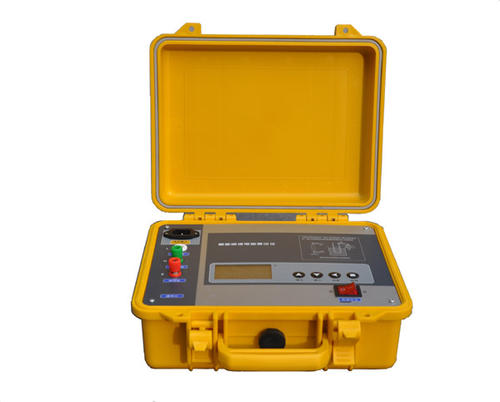

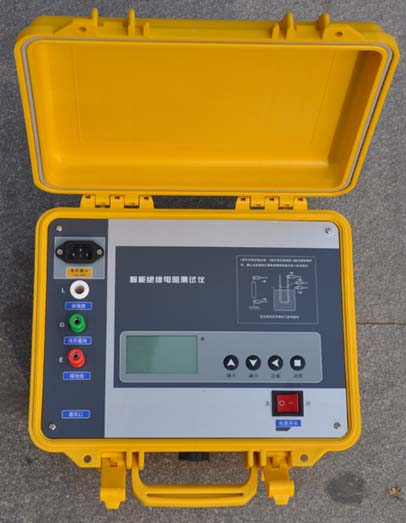
Loop Resistance Tester
The loop resistance tester (also known as a contact resistance tester or high-current micro-ohmmeter) is an indispensable "stethoscope" in power system preventive testing, handover acceptance, and daily operation and maintenance. It is specifically used to measure the contact resistance of conductive loops such as high-voltage switches, circuit breakers, disconnectors, GIS combined apparatus, busbars, and cable joints, and through accurate data it detects in advance heating hazards caused by contact oxidation, loosening, or ablation.
Based on your daily attention to the selection and procurement of power testing instruments, the following summarizes its core principles, selection pitfalls avoidance guide, and procurement suggestions for surrounding manufacturers.
⚙️ Core Principles and Standard Basis
The core measurement principle of the loop resistance tester is the DC voltage drop method (four-wire method/Kelvin connection). The instrument injects a large current into the circuit under test through a constant current source, while independently sampling the voltage drop across the test object, and calculates the resistance value according to Ohm's law (R=U/I). This four-wire structure can effectively eliminate the influence of test lead resistance and fixture contact resistance on micro-ohm level measurements.
In terms of standard basis, domestic testing must comply with DL/T 845.4-2022 "General Technical Conditions for Resistance Measurement Devices Part 4: Loop Resistance Tester" and DL/T 596-2021 "Preventive Test Code for Electric Power Equipment". The code clearly stipulates that in order to effectively break down the oxide film and oil film on the contact surface and restore the true contact state, the test current shall not be less than 100A.
Key Parameter Guide for Selection
When purchasing and selecting, it is recommended to focus on checking the parameters in the following four dimensions to match actual working conditions:
Test Current and Continuous Output Capability (Core Indicator)
Conventional scenarios: For 10kV-35kV medium-voltage switchgear, conventional circuit breakers, and disconnectors, selecting a standard 100A model can meet the vast majority of handover and preventive testing needs.
High-requirement scenarios: For 220kV and above ultra-high-voltage GIS, large-capacity generator outlet circuit breakers, or large cross-section busbar connections, it is recommended to choose 200A, 300A, or even 600A models. Large current can significantly increase the voltage drop of the measured section, improve the signal-to-noise ratio, and provide more stable readings in strong electromagnetic interference environments.
Pitfall avoidance tip: When purchasing, do not only look at the nominal maximum current; you must confirm whether this current is an "instantaneous value" or a "long-term continuous output value". High-quality instruments use high-frequency switching power supply technology and can work for a long time under high current with minimal temperature drift.
Accuracy, Resolution, and Repeatability
The loop resistance of power equipment is usually between tens and hundreds of micro-ohms (μΩ). The resolution of the instrument should be at least 0.1μΩ (high-end models can reach 0.01μΩ), and the accuracy class is usually required to be class 0.5 (i.e., ±0.5% reading + fixed error).
Repeatability is often more important than the accuracy of a single reading. In condition-based maintenance, the values measured multiple times at the same connection point must be stable. If the readings fluctuate greatly, it indicates that the instrument's anti-interference capability or fixture design has defects.
Structural Form and Power Supply Method
Outdoor/on-site inspection: Give priority to handheld or portable models. The weight is best controlled within 5kg (handheld models can be as light as about 1.5kg), with a built-in large-capacity lithium battery power supply, freeing you from the constraint of finding 220V mains power on site, and it needs to have an IP54 or above dustproof and waterproof rating.
Laboratory/workshop fixed testing: Desktop models can be selected, focusing on high precision, long-term stability, and complex data management functions, usually powered by AC220V.
Intelligence and Data Management
Modern power operation and maintenance have extremely high requirements for data traceability. It is recommended to choose models with temperature compensation (automatic conversion to the standard value at 20°C), threshold alarm (automatic red text prompt when exceeding the standard), built-in thermal printer, and support for USB flash drive/Bluetooth export of Excel or PDF reports, which greatly reduces manual entry errors and facilitates direct connection to the power grid's electronic archiving system. Common Models and Surrounding Manufacturers Reference
Common loop resistance tester models on the market include the HLY series (such as HLY-100A/200A/600A), GDHL series, SXHL series, etc.
In terms of procurement channels, the domestic power testing instrument industrial belt is mainly concentrated in two major regions: Yangzhou/Baoying in Jiangsu and Wuhan in Hubei.
Surrounding Jiangsu (Yangzhou, Baoying, Suzhou, etc.): A large number of high-voltage testing equipment manufacturers are gathered here, such as Yangzhou Zhili Electric, Yangzhou Huate, Baoying Zhongce Electric, Baoying Jiate High Voltage Electric, Suzhou Huadian Electric, etc. These manufacturers have advantages in the matching of loop resistance testers with complete sets of equipment such as test transformers and series resonance, and they are relatively close to you, making localized service response and after-sales maintenance more convenient.
Wuhan, Hubei: As a traditional important town for power equipment research and development, it has many brands such as Wuhan Guodian Xigao, Wuhan Huaneng Lianchuang, Wuhan Hezhong Electric, Wuhan Aiersen, etc., and their product lines usually cover a complete sequence from basic models to ultra-high-voltage intelligent models.
It is recommended that during actual procurement, you directly clarify to the manufacturer the main types of equipment to be tested (such as conventional 10kV switches or ultra-high-voltage GIS), whether outdoor handheld operation is required, and whether there are specific data export format requirements, and ask the other party to provide detailed selection drawings and third-party metrological calibration certificate templates to ensure that the equipment passes acceptance smoothly.