

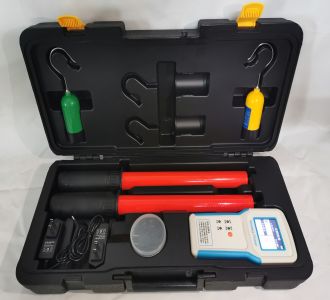
Insulation Resistance Tester
The insulation resistance tester, often called a "megohmmeter" or "megger," is a "health check instrument" for evaluating the insulation condition of electrical equipment. It applies a high DC test voltage to the device under test, measures the tiny leakage current, and calculates the insulation resistance value (typically in megohms MΩ or gigohms GΩ). This is crucial for preventing electrical accidents such as leakage and short circuits.
Core Principles and Functions
Working Principle: The instrument generates a constant high-voltage DC power source (e.g., 500V, 1000V, 2500V, etc.) and applies it between the conductor and the housing (or ground) of the equipment. Based on Ohm's law (R=V/I), it measures the tiny leakage current flowing through and automatically calculates and displays the insulation resistance value.
Intelligent Analysis: Professional testers can not only measure resistance but also automatically calculate the Dielectric Absorption Ratio (DAR) and Polarization Index (PI). These two indicators analyze the trend of insulation resistance over time to more accurately determine whether the insulation of large equipment (such as motors, transformers, and cables) is damp or aged.
Safety Design: Modern digital megohmmeters generally have an automatic capacitive voltage discharge function, which automatically releases residual high voltage on the equipment after testing, greatly ensuring the safety of operators.
How to Select: Voltage Level is Key
When selecting an insulation resistance tester, the primary consideration is the test voltage level, which must match the rated voltage of the equipment under test.
Table
Download as Table
Export as Image
Equipment Type Under Test Recommended Test Voltage Typical Applications
Low-voltage equipment 50V - 1000V Household appliances, 220V/380V motors, low-voltage cables, control circuits
Medium-voltage equipment 250V - 2500V Industrial motors, distribution cabinets, transformers, medium-voltage cables
High-voltage equipment 2500V - 10kV and above High-voltage switchgear, large generators, high-voltage transmission lines
Important Note: Never use the resistance range of a regular multimeter to measure insulation resistance! A multimeter only outputs a low voltage of a few volts to a dozen volts, which cannot simulate the real operating conditions of equipment under high voltage, nor can it detect insulation defects (such as micro-cracks or moisture) that only appear under high voltage. Its range is also far too low to measure acceptable insulation resistance (typically hundreds of megohms or above).
Standard Operating Steps and Safety Precautions
Safety is the first principle of insulation testing. Please strictly follow the procedures below:
Complete Power Off and Discharge
Completely disconnect the equipment under test from all power sources.
Fully discharge the equipment, especially capacitive devices such as motor windings, long cables, and capacitors. Use a discharge rod or grounding wire rated for the voltage level to ensure residual charge is completely released.
Cleaning and Wiring
Wipe the test terminals with a dry, clean cloth to remove dust, oil, and moisture.
Correctly connect the test leads:
L terminal (Line): Connect to the conductor part of the equipment under test (e.g., winding, cable core).
E terminal (Earth): Connect to the equipment housing or a reliable grounding point.
G terminal (Guard): When the surface of the test object is damp or dirty, connect to a shielding ring on the insulation surface to eliminate the interference of surface leakage current on the measurement.
Performing the Test
Select the appropriate test voltage level.
Start the test and wait for the reading to stabilize. For critical equipment, it is usually necessary to record values at 15 seconds and 60 seconds to calculate the absorption ratio.
During the test, strictly avoid touching any test terminals or exposed conductor parts.
Discharge After Testing
Stop the test first, then disconnect the test leads.
Discharge the equipment under test again fully to ensure personal safety.
🔗 Relationship with Tubular Electric Heaters
In connection with the tubular electric heaters you previously focused on, the insulation resistance tester is an indispensable tool for pre-installation checks, regular maintenance, and troubleshooting:
Pre-installation Check: For new heaters or those idle for a long time, the insulation resistance between the wiring terminals and the metal housing must be measured. If the resistance is below 1 MΩ, it usually indicates that the internal magnesium oxide powder is damp and must be dried; otherwise, leakage or breakdown accidents are highly likely after energization.
Regular Maintenance: Heaters used in humid, dusty, or corrosive environments should undergo insulation testing regularly (e.g., quarterly or semi-annually) to monitor trends in insulation performance.
Fault Diagnosis: When a heater trips or fails to work, first use a megohmmeter to check whether insulation failure has caused a leakage fault.